

A Reflection by Farhana Islam
From Living Soil to Classroom Learning
As a future chemistry teacher, I found this composting workshop particularly valuable because it showed me how chemistry can be taught through an authentic, everyday phenomenon. Chemistry is often introduced through formulas, equations, laboratory experiments, and molecular structures. Although these are important, students can sometimes struggle to see how chemistry connects to their everyday lives. Composting provides an opportunity to begin with something students can observe, measure, and experience directly.
For example, a teacher could begin a lesson by asking: “Our compost pile was 25 °C yesterday, but today it is 50 °C. Why?” This simple observation could lead students to investigate microorganisms, cellular respiration, energy transformations, oxygen, carbon, nitrogen, and decomposition. Students could measure the temperature of a compost pile over several weeks and create a graph of the changes. They could identify the mesophilic and thermophilic stages and explain why the temperature eventually decreases. They could also investigate what happens when one condition in the system changes.
For example:
- What happens if the pile is too dry?
- What happens if it is too wet?
- What happens if we do not turn it?
- What happens if the materials are chopped into smaller pieces?
- What happens if we change the amount of green material?
- Why does a larger pile retain heat better?
These questions allow students to move through an authentic scientific process:
Observe → Question → Predict → Investigate → Measure → Explain → Reflect
For me, this is where composting becomes a powerful pedagogy for chemistry. Instead of simply learning about chemical and biological processes from a textbook, students can investigate a living system and develop explanations based on evidence. The compost pile becomes a kind of living laboratory where abstract scientific concepts become visible and meaningful.
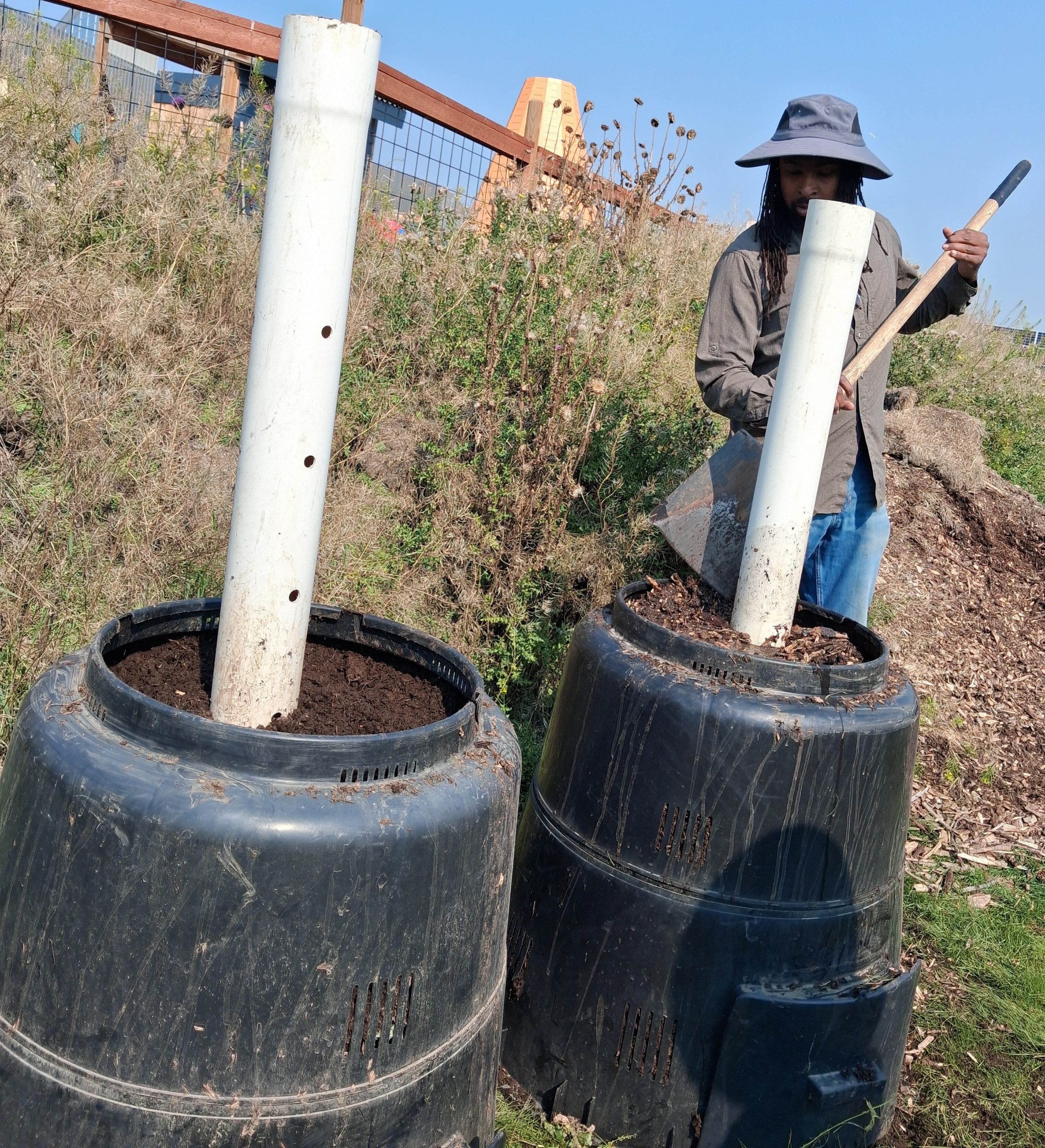
Picture: Two compost bins after filling with all the raw materials
Composting as Transdisciplinary Learning
The experience also showed me that composting cannot be placed within only one subject area. It provides opportunities for meaningful transdisciplinary learning.
It involves chemistry through energy transformations, carbon and nitrogen, respiration, and decomposition. It involves biology through microorganisms and their metabolic activities. It involves ecology through nutrient cycling and relationships between organisms and soil. It involves environmental science through sustainability and the transformation of organic waste into a useful resource. It also involves mathematics through ratios, temperature measurements, mass, volume, graphing, and data analysis.
Most importantly, composting connects these areas through an authentic problem that students can investigate. Students can collect data, work collaboratively, ask questions, identify patterns, and develop explanations from evidence. This makes composting an excellent example of how learning can move beyond individual subject boundaries.
What This Experience Taught Me
The experience changed the way I think about composting. Before the workshop, I would have described composting simply as the decomposition of organic materials. Now, I understand it as a dynamic system that depends on the interaction of microorganisms, organic matter, temperature, oxygen, moisture, mass, and time. I also learned that science could become visible through simple measurements and observations. A thermometer can provide evidence of microbial activity. A change in texture can indicate decomposition. A change in smell can provide clues about the conditions inside the pile. Changes in temperature can help us understand different stages of the composting process. These observations can become the starting points for scientific questions and investigations.
This experience also changed how I think about the role of a teacher. Rather than always providing students with the answers first, I would like to create learning experiences where students have opportunities to observe phenomena, ask questions, collect evidence, and construct explanations. Composting provides a meaningful context for this approach because the system is constantly changing and responding to different conditions.
Conclusion
The hot composting experience was much more than an opportunity to learn how to make compost. It gave me an opportunity to think about the relationship between science, sustainability, community, and education. I was particularly inspired by the idea that materials we often consider waste can become part of a regenerative cycle. Coffee grounds, wood chips, mushroom compost, and weeds can be transformed through microbial activity and eventually contribute to healthier soil and medicinal gardens. As a future chemistry teacher, I left the experience thinking about how I can bring similar authentic experiences into my classroom. A compost pile can become a living laboratory where students investigate temperature, energy, matter, microorganisms, carbon, nitrogen, oxygen, and decomposition. It can also provide opportunities for students to connect scientific knowledge with environmental responsibility and their own communities. Most importantly, students can learn that chemistry is not something that exists only in a textbook or laboratory. Chemistry is happening all around us. A compost pile getting hot is chemistry. Organic matter breaking down involves chemistry. Energy being transformed involves chemistry. The transformation of what we consider waste into something that supports new growth is also an opportunity to teach students not only about science, but about care, sustainability, and our relationship with the living world. This experience reminded me that some of the most meaningful science lessons may begin with a simple question:
“What is happening inside this pile, and how can we use what we learn to care for the world around us?”
 Soil Camp