

Since its inception, Soil Camp has been inspired to collaborate with people across different disciplines; connected by a shared love for the land, its histories, and possible futures. Our efforts to broaden our dialogues also led to the expansion of our geographies of learning when we invited artists Skye Louis and Karan Patel to discuss their motivations, approaches, and philosophies toward art in an online discussion. The conversation seeded the idea of Skye facilitating an Indigo-dyeing workshop with participants at Soil Camp. This article highlights some of the themes animating these artists’ respective work, philosophies, and discussions of the generative possibilities of continuing such cross-border conversations.
About Skye and Karan:
Skye Louis is a Goan-Torontonian printmaker and arts educator based in Calgary/ Moh’kinsstsis. Skye’s art focuses on experimental processes, material transformation, and thinking through ‘making.’ Recently, Skye has been doing creative placemaking in the local community garden, working alongside gardeners and other artists, to find and distill colours from garden plants. Skye likes to make complex ideas more accessible through hands-on experiences. She believes that plants have a lot to teach us about the land, our histories, and ourselves.
Karan Patel is a designer, permaculture practitioner, and researcher from Gujarat, India. His work focuses on the interconnections of human life and meeting human need for food, shelter, clothing, education, healing, and entertainment in an ecologically sensitive manner. Karan specialises in sustainable sources of natural colours in various applications that include paper, textiles, walls, and pottery. He has recently started a clothing brand ‘Stone Wear’ based on naturally dyed and sustainably harvested cotton fibre. He is the founder of Aanushrav, a platform that aims to connect like-minded individuals, and facilitate collaborations on projects designed for sustainable living.
On cultivating relationships with the land through art
For Karan, it all started with food. Karan grew up in urban spaces, with minimal connection to nature, as is typical for children in urbanised environments. It was not the occasional encounters with rural ways of living, when visiting relatives, that made a lasting impact on his rudimentary ethos. Rather, it was Karan’s undergraduate studies in food processing that led him to ponder food systems seriously. The course content—while theoretical and alienating—had awakened in him an intense longing to explore the hidden interconnections underlying food systems. The backdrop of farmer suicides in India for instance, led Karan to question how those responsible for the food security of a nation, could be in such dire circumstances. Karan spent a year with farming communities to better understand the challenges, opportunities, and dominant – yet, misleading – narratives of development. His experiences convinced him that without centering the import of sustainability and multispecies wellbeing, any proposed solutions would only solve problems in a temporary manner, thus creating bigger problems as a trade-off.
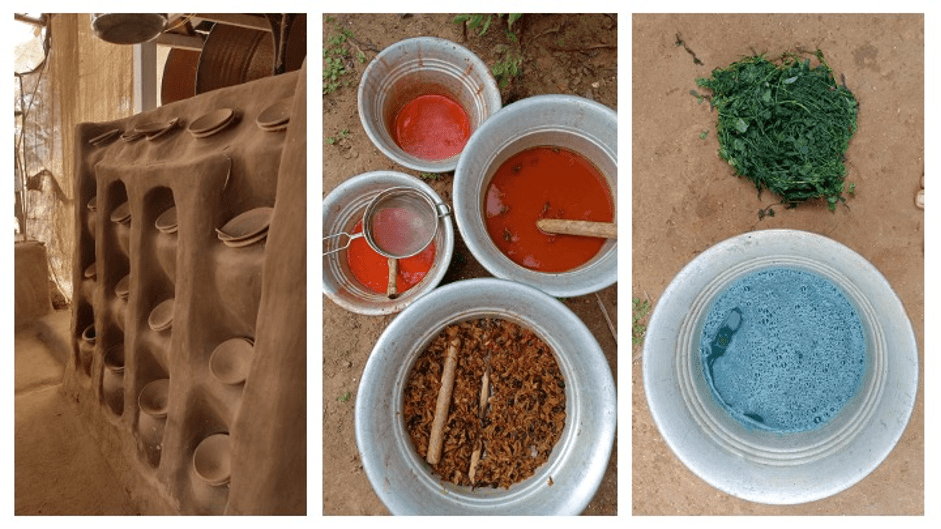
Karan eventually felt the need to explore and understand sustainability in depth by learning from his immediate environment, as well as from traditional wisdom, knowledge, and forgotten skills. For more than seven years now, Karan has been exploring various facets of regenerative agriculture and sustainable architecture in his quest to develop an ecologically responsible version of essential human needs – food, clothing, and shelter. In the process, he has also realised that artistic expressions are equally vital for a fuller life. He had the epiphany after building an entire kitchen and room, with a stove and storage made from mud,
“When the studio was ready, it was beautiful, like, you know… but I didn’t like it. That aesthetic, because it was all gloomy. Your walls and floor, everything was brown. That’s how I realised that colour is a psychological need… So I began looking around, you know, where do I get colour sustainably? Because now we cannot go back to the pristine forests, mountains, and rivers to pick up stones, as we have overmined and overexploited those places. So how do I get colour without damaging the ecosystem?”
So, he began experimenting with natural colours from local sources in earnest; slowly finding more connections with the local geography and vegetation in the process.
Skye explained that she sees art as a fundamental part of life and humanity; rather than a luxury that one can afford only if one has the time or money. For Skye, art is just part of the way we observe, interact with, and understand the world around us. This idea took a more pragmatic turn for Skye when she offered online screen-printing classes for people isolated at home during the pandemic. She decided that they would make the inks from scratch and encouraged participants to scavenge resources from around their homes. She found the process quite empowering,
“That’s really exciting, because it’s kind of giving the power of art making back to people. It’s like you don’t have to go out and buy something. You can actually make the materials and use what’s around you. And so we made the screens. We hand-cut the stencils, and we even made our own inks, and I wouldn’t say the inks were very elegant, but they worked. You know, we did things like we used different things from the kitchen and whatnot. So I got really curious about inks—how inks have been made historically before our modern inks that are full of plastic. And I just kind of like fell down this whole rabbit hole of inks and dyes, and how these materials work, and the skills that you need to make them and use them. And how those skills are actually like, really, deeply tied to the land.”
The experience led Skye to reflect on the extensive connections between traditional craft and local geographies, which in turn must have supported the cultures that evolved from these shared practices.
“And if you think of human history as this kind of river that’s flowing down from the past that we’re part of craft, knowledge, and traditions tied to the land are also part of all of those histories.”
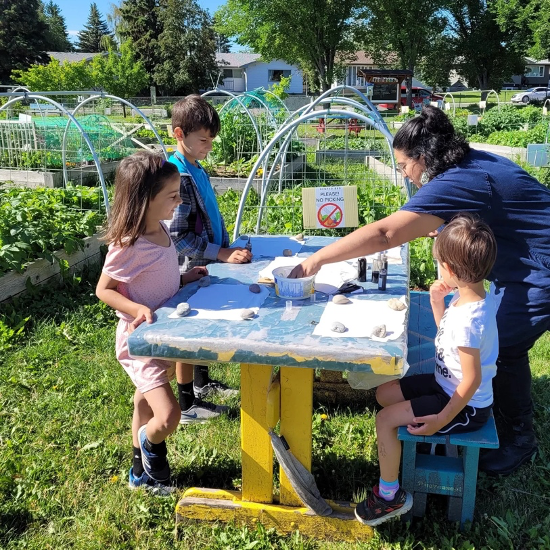
Turning to the land as inspiration for art, has also led Skye to notice what’s happening around them in their local community garden; eliciting such essential questions as: how can they develop new and deeper relationships with our more-than-human world? Describing the joy of the process, Skye commented,
“We’re working directly with the plants. It’s this kind of direct encounter with these beings that is so magical to me, like, I just think plants are amazing. So it’s just incredible to be able to work with them closely and kind of develop that relationship in a new way for me.”
Preserving nature and culture in a changing world through art
As an immigrant – whose parents are from Goa, India – Skye described how immigrants often carry with them stories of loss and remembrance. Reminiscing on her personal experience, she mentioned that she was born in Toronto, and later moved to Calgary, but still yearns for an imagined time and place that could embrace the wholeness of her identity instead of leaving her torn between different cultures and places. She explained,
“So there’s a part of me that’s like delighted and amazed by, like the aspen and the saskatoon berries and the wild crocuses that you can see around here where I am, and I feel that I’ve really learned a lot from them about like how to live in this place… But there’s another part of me that just wants to be like immersed in matter and indigo, and all of these incredible, beautiful plants that are part of my craft heritage. But there’s a reality to the climate here, which means it’s just not possible to grow something…”
Skye, however, chooses to stay with the tension and work through these challenges. She feels that traditional art practices are also the culmination of centuries of embodied knowledge, now equally endangered by degraded ecosystems, colonial violence, and warped economic logics that impact communities. Thus, when conducting workshops on Indigo dyeing, Skye also embraces the responsibility of keeping endangered knowledge practices alive.
Karan agreed that artists face the dilemma of adapting to newer conditions versus preserving dying practices. He gave the example of a traditional blockprinting practice in Western India called ‘Ajrakh’, which originally developed near rivers, requires repeated immersion of fabrics in clean water. However, the river’s course changed abruptly due to a combination of human interventions and natural causes. As a result of the unavailability of quality groundwater, the practice slowly dwindled with time. In recent years, the State government has made efforts to revive the craft, but without paying attention to the sustainability of the water supply, the craft is ironically being deemed unsustainable. The situation is slowly changing through local innovations in the art form and sustainable use of water. Karan thus felt that current ecological conditions need to be in constant dialogue with traditional craft making and how it may evolve.
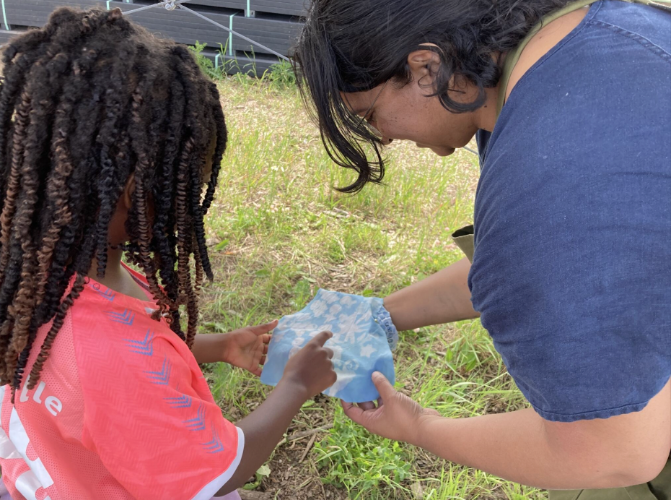
Skye felt that engaging in embodied experiences is perhaps a central practice for countering the disengagement and alienation many people face today. Reviving and innovating craft forms is not just about artisanry, but also about reaffirming relationships that support such practices. Citing her own example, Skye mentioned,
“It’s all about the hands-on embodied learning. So you know, when I physically grow a plant myself, and then I watch it every day, and then I water it, and I harvest parts of it for food and parts of it for colour, and then I process the colour. And then I create art with that material. It’s just this, like, really amazing way to connect with you know, these creatures that we share the earth with. And it’s truly transformative, because it’s about this experience that you’re going through… You’re not sitting in a classroom and getting knowledge poured into your brain. It’s like you’re actually doing it. And it changes you. And it changes how you see the world around you. And when I work with groups, I really see that transformation happening. And it’s like, it’s so exciting. It’s ridiculous. And it’s like, that’s what’s giving me hope right now, is just paying attention to what’s going on around me and learning from the plants, learning from the animals. It’s a good reminder that the world is bigger than humans.”
Skye and Karan’s reflections highlight how art is not an incidental addition to lived experiences, but is instead woven into the meaning of being human. Through millennia, people have been inspired to create art from their immediate environment, but generations of knowledge practices are also endangered in the face of ecological crises. Delving into their experiences, both Skye and Karan show that a deeper, authentic engagement with art can offer ways to reconnect with nature, thereby nurturing a new generation of beings that pave the way for a life rooted in ecological reciprocity.
A Reflection by Deborah Dutta
 Soil Camp