

Reflection by Deborah Dutta
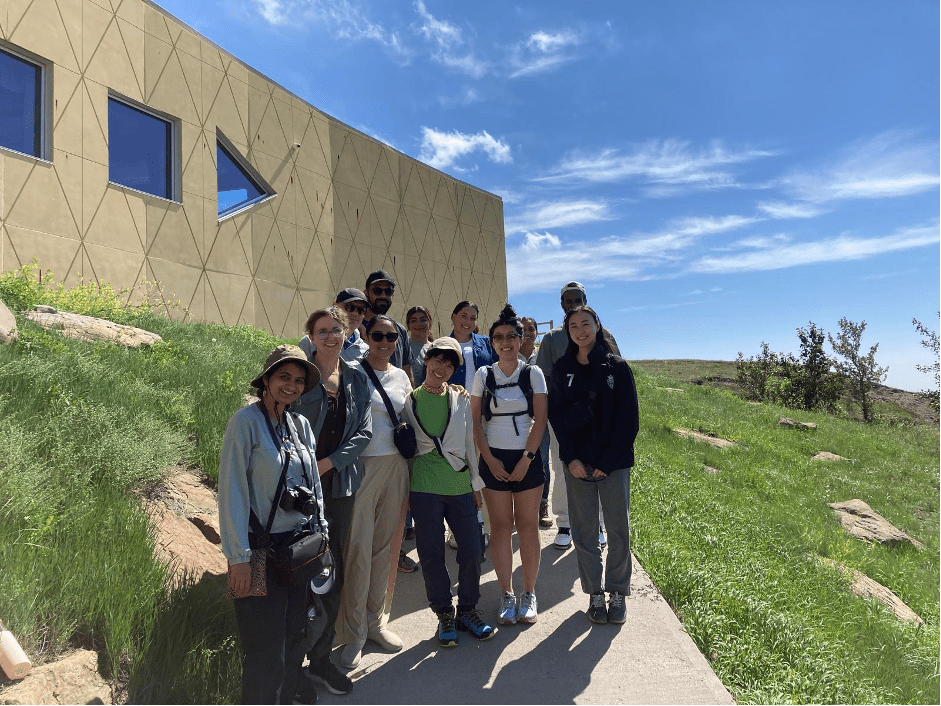
It isn’t every day that one has a chance to stand on grounds that witnessed pivotal moments in history. Standing before the elegant building at Blackfoot crossing, felt like one of those significant moments in my life. 148 years ago, on 22 September 1877, a series of events led to the signing of Treaty 7 between the five First Nations, led by Chief Crowfoot and Canadian Settlers near this site. The facilitators of Soil Camp had decided to partake in a field trip that would not only commemorate the culmination of sessions this year, but also allow for some time and space to reflect on our own individual journeys. It took us about an hour and a half to reach the site, which is located on Siksika Nation and situated along the Bow River. Along the way, we were greeted with views of rolling plains and hills – stretching as far as the eye can see. The landscape interrupted only by granaries and large agricultural machines; a reminder of the prevalence of intensive monoculture practices. Given the unusually rainy summer, the prairie grass was still noticeably green. We made our way into the building, beautifully adorned with Indigenous motifs. I later read that the centre was designed by Ron Goodfellow, who wanted to represent Blackfoot culture, and everyday life, as part of the architecture. The striking entrance is thus embellished with glass panes shaped like an Eagle Feather Fan; honoring the sacredness of the eagle in Siksika ceremonies. The centre itself consists of a museum, a canteen, a small theatre, and interpretive trails all within the vicinity.


Our tour began by watching a short movie featuring a young Blackfoot woman. In it we were given a guided tour walking through an old house filled with artifacts and memories of the protagonist’s ancestors; explaining in the process: the history of subjugation, residential schools, and contemporary efforts to ground the community in their culture (while also preparing themselves for societal expectations). Seeing it, however, reaffirmed for me, the fundamental violence and violation, embedded in modern societies based on colonial neoliberal logics. As an educator, existential questions (of what we count as education); such as: whose knowledge is valued, and what aims do we hope to achieve through education – come into sharp relief – against the histories and identities suppressed to create narratives of modernity and progress.
On exiting the theatre, we were greeted by Grant Many Heads who introduced himself as the Guide for the museum tour. He started by explaining the Old North Trail that extends from Mexico to Yukon and how it was well-known to Indigenous Peoples. He said that tribes had moved along this route, that was designated the “backbone of the Earth” for thousands of years.

Grant described the Blackfoot way of life, how it involved close relationships with dogs, and how they became known as the Dog People (horses not common until the 17th century). As they lived a primarily nomadic existence, they carried materials to set up Tipis (they don’t use this word traditionally and instead call it Niitóyiistsi). They would set up camps for longer periods – however, only during winter – when it is said to have been difficult to move around (for as long as six months). Grant spoke in an animated and engaging manner, relaying the events as if they were unfolding in real time for him. He described how his people had to cross rivers; with the Bow River near Calgary (Mohkínstsis[1]) being particularly deep and wide – making it difficult to cross. He explained that to cross the river, the clan had to move west toward Banff, or east toward what is now known as Blackfoot Crossing and the “Ridge under Water.” The area has been a hotspot of trade for over 2000 years, with archaeological digs showing perforated bones, volcanic ash, and shells from the Pacific, including ‘White Man’ trade goods; indicating that trade was vibrant, even before formal interaction with settlers. He commented that his people have been here for more than 18,000 years – a number that far exceeds Western calculations.
Grant then narrated the painful history of a broken treaty with the U.S., which preceded Treaty Seven signed with McCloud (on behalf of Canada) in 1877. He described the whiskey trade, which began at Fort Benton near Missouri and ended up as an exploitative business of selling dangerous, adulterated liquor to Indigenous Peoples in exchange for fur goods. It started a vicious wave of addiction, and coincided with a smallpox epidemic that annihilated one-third of the Blackfoot community. Simultaneously, settlers had all but killed the bison herds, crucially central to Blackfoot existence regarding culture and food.
Grant illuminated that the Blackfoot people became receptive to General McCloud’s offer of a treaty when he promised to remove the whiskey trade (a plight that had caused much misery among them). When they saw him keep his word, they felt inclined to believe him. But even then, it was not much of a choice, because other Indigenous nations had already signed Treaties 1-6, and when it came to them, they were surrounded by armed Canadians and their Indigenous enemies. Chief Crowfoot eventually signed the treaty on Sept 21, 1877. Grant explained that for them it was never ‘land surrender’ but ‘land share,’ and that they had never forsaken the treaty, unlike other nations who had engaged in rebellion. However, as a punitive measure against all the nations, Indigenous people were forbidden from exiting the reserved territories until they had a pass issued by a White man, who would be the ‘Indian Agent’; a practice that continued until the 1970s. He also stated that the Indian Act was written in 1876, and never discussed with the Blackfoot chief when he signed the treaty in 1877. The reserves continue to be challenging spaces to live with water issues and a lack of access to fresh food; despite relative autonomy from the government and a few other benefits.
Grant led us to the museum, which is arranged around four tipis – each of which highlights a particular part of Blackfoot history and culture. He narrated creation stories and declared that their original treaties were with animals and were regarded as sacred. He explained in detail the buffalo hunting practices, storage of food, and strict regulations around the fur trade. He also described cultural difference between various Indigenous communities in Canada; as their distinct cultures and knowledge practices, are often homogenized and flattened into a single category. The museum had exhibits on various artifacts and memorabilia, as well as a dedicated exhibit on Chief Crowfoot (who incidentally, was buried at the crossing).
Later, we walked on a trail with a Guide named Mat. Along the way, we saw chokecherries, saskatoons, silver buffalo berries, female sage, horse tail, wildflowers, wild strawberries (still in bloom), cat tails, and wild mint. We also saw coyote droppings, with Mat mentioning that he once saw a Mountain Lion in the area. He shared that he had also seen porcupines scuttling down the paths. We came near the banks of the Bow River, and the actual crossing was a few kilometres upstream.

Walking back, I thought about our humble attempts to listen to the soil and the Land through the activities at Soil Camp, and the ways in which the space continues to teach us about their histories. Places like the Blackfoot Crossing have undertaken the task of remembering and honoring painful histories, while turning them into powerful stories to shape and inspire just futures for the Land, and its human and more-than-human inhabitants. Listening to the impassioned voice of Grant Many Heads reaffirmed the fact that history is ever-present, and the future is always here.
[1] Found this interesting article on the politics of naming, which also speaks of the historical tension between different Indigenous Nations. It also cautions against the assumed flattening, appropriation and homogeneity of Indigenous cultures by outsiders. https://www.sprawlcalgary.com/you-cant-just-take-a-name
 Soil Camp