

A Reflection by Afoke Oyibocha, Edited by Soil Team Members
On a sweltering summer evening, I attended a Soil Camp workshop on 'Composting' at the Land of Dreams. The sun had just dipped below the horizon, casting a warm glow, that I shielded my eyes from with my hat. As I walked along the path, I spotted a dandelion and recalled all I had heard about this plant. Weeds were often described as menacing, notorious for out-competing and draining life from the more desirable plants. They needed to be eradicated, to prevent them from overpowering their more favorable counterparts. My thoughts came to a halt when the question “What is a weed?” was posed. It struck me that I had never truly questioned my preconceived notions of weeds beyond the belief that perhaps a few could be of benefit to humans. At the workshop, I learned that a weed is simply a "plant out of place," which sparked my exploration into the idea of weeds and their marred classification.

Weeds have been the subject of decades of debate, prominently within the framework of ecology, where these conversations often focus on such topics as biodiversity, the climate crisis, and human impact. Once a plant is termed a weed, it remains so, even if its relationship with the environment evolves. In this context, weeds are often the byproduct of human activity—manifestations of deeper discordance with the land. Substantial debate exists about whether weeds are opportunistic species that flourish in degraded regions, or whether their proliferation (often at the expense of indigenous species) results from continual "soil violence." Numerous studies, moreover, indicate that when soil health and plant diversity are restored, weed populations diminish.

My argument, however, centres on the socio-cultural and anthropocentric nature of weed classification. What duty, if any, do we owe to non-human beings? This work investigates how the classification of "weed" is itself a social construct, shaped by human perceptions and values. The video: 'Weeds in Art: Growing in the Shadows of Power' by Giovanni Aloi delves into this concept, arguing that weeds hold multiple meanings, particularly within contemporary art spaces; where they symbolize counterculture and resistance. This idea resonates profoundly in the work of Nigerian artist Precious Okoyomon, whose installation 'Resistance is an Atmospheric Condition' invites viewers to reconsider the narratives surrounding weeds and their roles in our ecosystems. Through this lens, I aim to bridge discussions of weeds as a symbol of defiance in the face of human imposition. By examining the philosophical implications of our relationship with these plants, I hope to uncover complexities that challenge traditional views and inspire a more nuanced understanding of nature's tenacity.
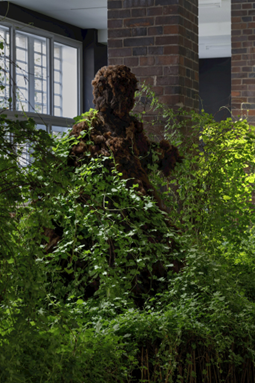
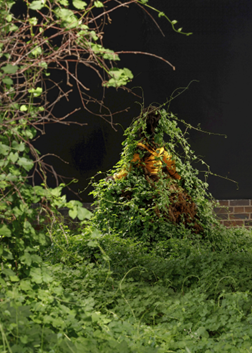
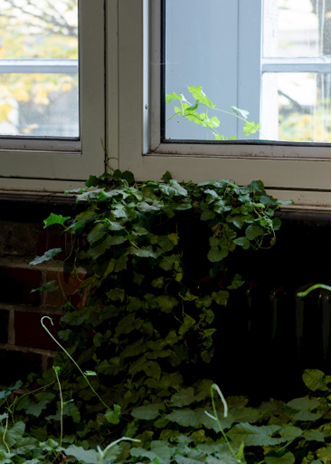
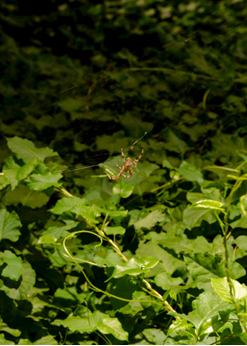
Imagine walking into Okoyomon’s installation (above), where a plant coined “Kudzu” climbs the walls; overtaking the space, and reshaping its essence by entwining itself like yarn over sugarcane, which grows freely alongside it. The human observer navigates this overgrown terrain—a space clearly not designed with their presence in mind. Images formed from soil and twine in this art piece resembling ancient African deities: anthropomorphic, yet distinctly non-human – with extended arms and expressionless faces. Kudzu, often labelled a noxious weed in the American South, has become a symbol of corruption and contamination. Described as having “eaten the South,” Kudzu blankets the land in thick, green sheets, consuming everything in its path. Ironically, this plant, now a symbol of unchecked “invasion,” originates from Japan and was deliberately introduced to America in the 1930s.
The connection between Kudzu and the South is deeply intertwined with histories of slavery and exploitation. Years of forced labour on cotton plantations, left Southern soil barren and eroded. Dust storms devastated the region, prompting fears of economic collapse. Kudzu was introduced as a solution, with farmers paid to cultivate it on ravaged land. Initially requiring careful tending to establish itself, Kudzu soon grew unchecked—a new monoculture replacing the old. The villainization of Kudzu began when it became clear it held no real economic value. Once seen as a savior, it became a scapegoat, draining the land like wringing out the last breath of a dying flame. This space, overtaken by Kudzu, serves as a reminder of a history where nature itself is bent, reshaped, and manipulated to serve human desires; a cycle of displacement and domination – that leaves the landscape fundamentally altered.
Eroded soil plays a significant role in shaping narratives about weeds. In Yota Batsaki’s article: The Plant at the End of the World: Precious Okoyomon’s Invasive Art; soil is portrayed as a bridge between nature and culture, serving as an archive of their interactions. As a finite resource, soil holds the memories of the past, and with the emergence of weeds from its depths, Batsaki argues, that these plants challenge social and cultural norms. Similarly, Aloi poses a critical question:
What is at stake with the proliferation of these weeds?
Is it our national identity? Historical narrative of each nation? Or perhaps, the future of ecosystems?
Each perspective profoundly influences how we perceive weeds. The phrase: “resistance is an atmospheric condition” serves as a metaphor by suggesting that resistance (much like the climactic atmosphere itself) – is a pervasive and constant force; shaping the environment or situation it inhabits. So, just as weather influences landscapes; so too, does resistance have power to mould social, political, or personal dynamics.
The alternate title of Okoyomon’s piece, draws inspiration from Ed Robertson’s poem: ‘To See the Earth Before the End of the World,’ evoking apocalyptic imagery. Critics of this perspective, argue it is overly Western-centrist, amplifying the fears of those in the global North meanwhile, ignoring the lived realities of many global communities already experiencing their own “end.” Okoyomon’s installation offers an alternative vision of post-Earth plants reclaiming liminal spaces and resisting human-imposed binaries of right and wrong. A perspective that invites reflection on the relationship between nature, culture, and resistance – challenging the passivity implied in the phrase “plants out of place.” Weeds often carry histories that are far from passive—histories like that of the “white man’s foot,” a weed symbolizing European colonial violence. That, I believe questions rhetoric that plants are simply displaced at our convenience.
Weeds carry symbolic weight in art, culture, and society; revealing a duality that complicates their negative perception. Their autonomous nature – defiant to human control – makes them effective symbols of resistance. I would venture to argue, that the classification of plants into categories like “native”, “invasive”, and “weed” is itself rooted in human constructs that often disregard Indigenous knowledge and pre-colonial histories.
Kudzu’s story, tied to human migration, exploitation, and endurance, reflects how plant histories mirror and sometimes chronicles dominant human cultural narratives. Language is a powerful tool that bridges the way we relate to non-human beings and ourselves. That is why I think it is also crucial to recognize connotations and symbols derived from such terms as: “weed” (or separate from plants); thus, religating something—or someone— to being viewed as foreign, different, or as the “other.”
Reconsidering our relationship with weeds offers an opportunity to reshape our connections to the environment, land stewardship, and one another.
To me, nature grants weeds a role that defies human imposition; creating a narrative where human control is not the dominant story. We tend to shun weeds, expecting nature to follow suit and conform to our notions of “righteousness” – regarding certain plants, yet the reality is far more complex. As one strolls through Okoyomon’s installation, we will find ourselves on the brink of imagining a future where human influence holds little sway over the earth’s offerings; experiencing the planet in its full, unvarnished glory – laid bare before what may be the end of the world. This vision invites reflection on our relationship with nature, urging us to reconsider the narratives we create around plants and the resistance they embody.
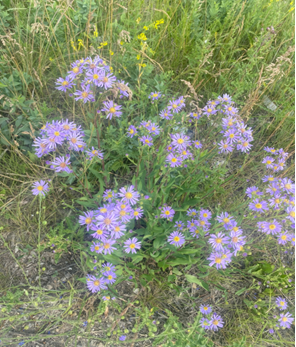
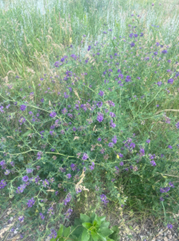
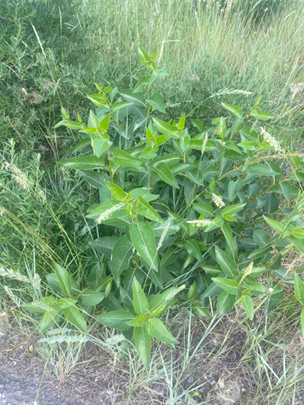
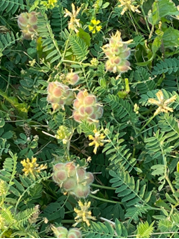
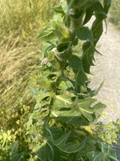
Biodiversity at Land of Dreams
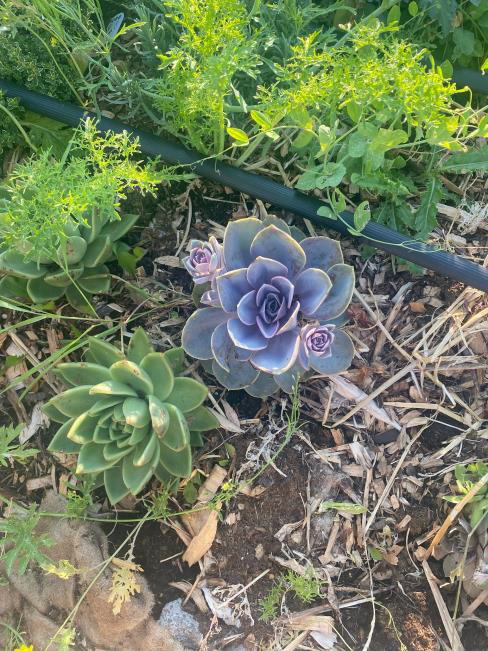
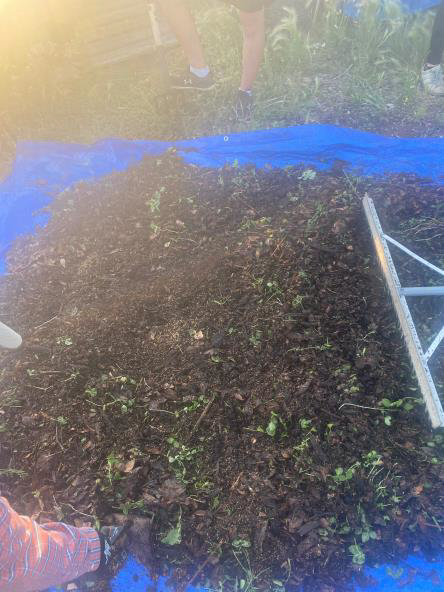
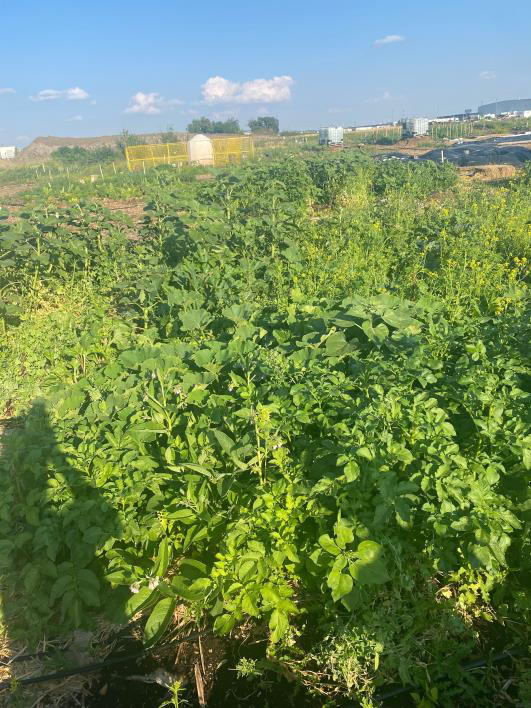
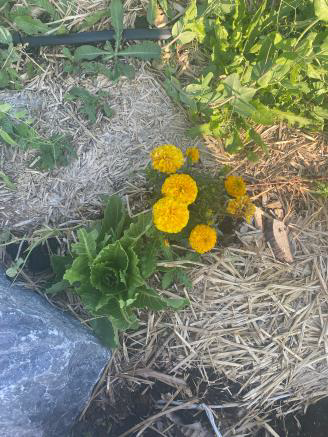
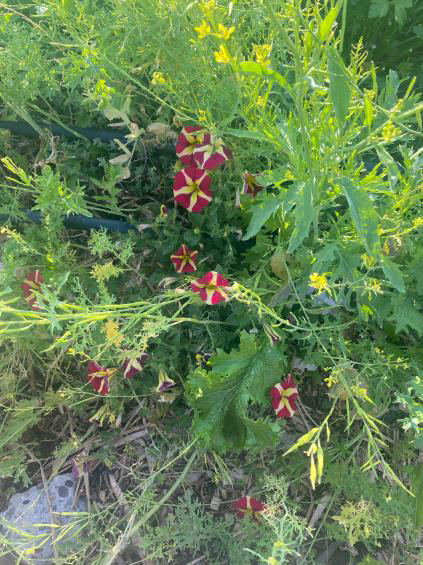
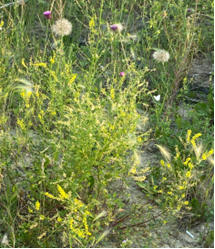
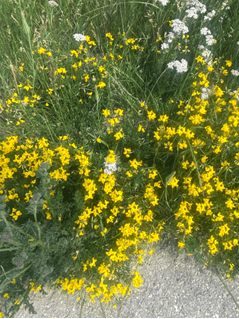
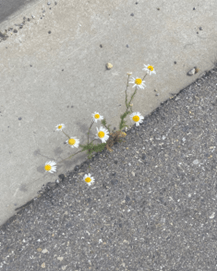
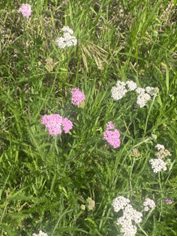
Flora in the Calgary NW Region of Nolan/Sage Hill
Bibliography of further readings:
 Soil Camp