

Written by Afoke Oyibocha, with contributions from the Soil Camp Team

The art form of zines has been popularized and re-popularized at various times throughout history. In the 1930s, comic zines allowed fans and audiences to connect with beloved characters and create stories; often through imagery, that narrated all manner of things. Another significant period in ‘zine history’ is the Riot Grrrl movement of the 1990s. These third wave feminist movements, truly sparked my curiosity about zines and how they are used in conversations of resistance and liberation. Riot Grrl emerged as a push-back against the violence and degradation that female audiences in the punk subculture experience. The movement started with zines, but Riot Grrrl quickly became an uncontainable force, extending beyond written and drawn content, to outward expressions of female rebellion through music and song. Therefore, I feel that zines allow for subversive, creative expressions, and conversations. They capture personal and collective experiences; allowing for a unique form of storytelling and connection. Through zines, we can explore and document our histories, resistances, and aspirations – making them a powerful medium for creative dissent and change.
I won’t lie; another reason for choosing to create a zine, was as a direct response to ongoing conversations about how education is developed and taught. Much of this writing, expands on conversations with teachers within Soil Camp; including, a YouTube video I watched, that reflects my desire to respond to, and contribute to the discussion. The video entitled: ‘The Death of the Humanities: Education in the Capitalist University,’ resonates with trends I’ve observed too. I believe that we are seeing a shift towards a world, increasingly dominated by techno-scientific enterprises, whose primary aim is to generate capital; particularly, with the rise of technologies like AI. Such trends serve to reinforce dominant, narrative dogma based on Eurocentric conceptions of scientific knowledge.
While the sciences are invaluable, they are not the only way to acquire knowledge. As Indigenous Elders would explain, there are multiple ways of scientific inquiry. Observing children share their understandings through drawing and sensory experiences, only reinforces this idea. Moreover, it seems there are very few initiatives that encourage the pursuit of the arts. My colleague, Deborah’s remark, of how nice it was to see people, especially adults, take the time to engage in an art activity at one of our zine-making sessions – echoes this sentiment. She posed a very thought-provoking question: When was the last time we had time to draw? I myself, was embarrassed to realize I couldn’t remember. Below, you will see a sneak peek of artwork produced by the participants (including Soil Camp parents, their children, and facilitators) of our zine-making workshops – in the slideshow below (please click the arrows to scroll through):

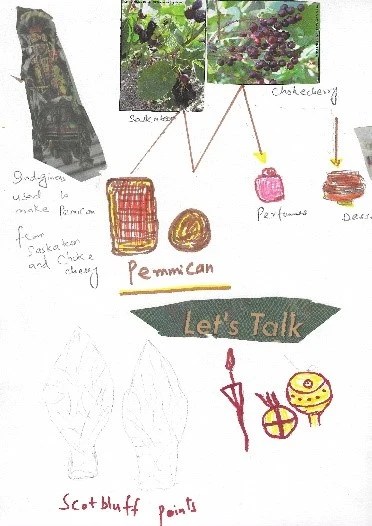


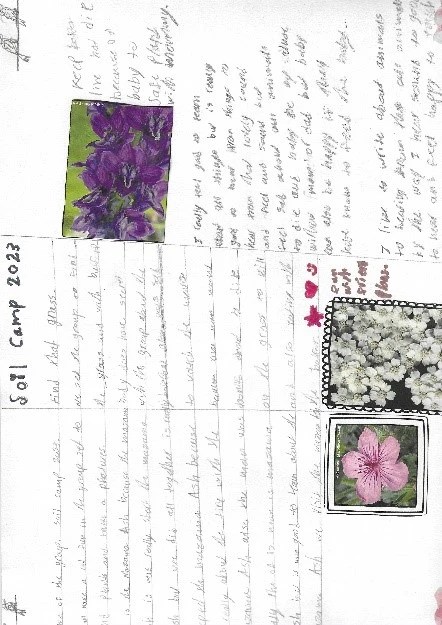
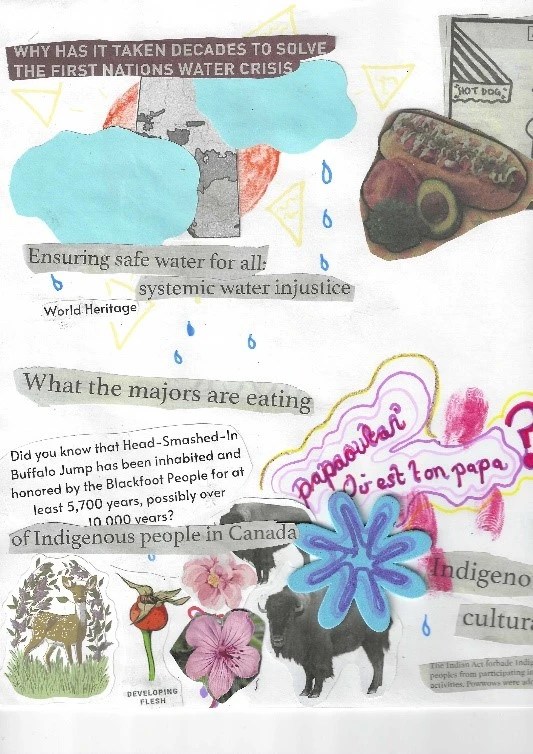
With this zine, it should be noted that we are creating works that are produced by labour, not for sale, but for everyone’s collective enjoyment and enrichment – which is profoundly meaningful. During the first session of creating the zine, I was scribbling and cutting out elements to shape its theme. Words like “systemic water injustice” and “stampede” began to stand out on the page. There was also a cutout of a cowboy that I, along with many other children, had used from a stack of old newsletters (obtained from the University of Calgary). I aimed for the zine to be explicitly political, while simultaneously ignoring the inherently political circumstances, that brought us together in the library in the first place.
Sophia, a co-facilitator of the workshop, had asked the family we hosted if anyone wanted to play songs while they drew. The younger child enthusiastically requested “Papaoutai,” this brought back a flood of memories. I remembered hearing this song in class, and how the song and video, refer to the absence of the singer’s father who was killed in the Rwandan genocide. The influx of refugees and immigrants from various African countries reflect the continued state of violence and exploitation.
The song also reminded me of my conversation with a parent named Theo during our trip to Head Smashed In Buffalo Jump (Estipah-skikikini-kots). What started out as small talk about what he was growing on the community farm – Land of Dreams (bitterleaf)- spurred into conversations about the landscape of the Congo. He commented on how corporations like ‘Apple’ are complicit in the continued violence, for a valuable resource called coltan (found in many technological devices). I then remember Theo pulling out this photo of the most glorious green landscape that I have ever seen. Making the zine, I added this visual on one of the pages. He had also mentioned working at the zoo in the Congo, and the “strange striped animals with slender necks” (oddly enough, that could only be fed from a heightened position – as they do not tilt their heads downwards). The okapis, he described to me, looked much like strange giraffes.

Such organic connections were evident in everyone’s drawings. Every element from their contributions, went into making the zine – like a patchwork of personal, yet collective stories. The apparent messiness, is a reflection of our entangled lives and circumstances, that brought people from widely different cultures and histories together – to share an afternoon walking on Indigenous Lands and learning its history. Building on that idea, I believe the ethos of Zining stands in stark contrast to the ‘elitism’ often found in academia, where the conductors of research, are often disconnected from the lives of the people they observe. However, in contrast to these often exclusive and gate-keeping forms of academic knowledge – zines serve as rich conduits of information; promoting open sharing of collective sense-making. To me, it feels like a practice in democratizing information and fostering inclusiveness. Zines “wear their hearts on their covers,” so to speak.
My discontent with academia and its handling of the humanities, grows with every conversation in the classroom; such as when I am transported back in my mind, to a past political science class, to discuss mundane topics, vastly removed from substantial current events. The topic of Palestine in these instances, often feels like a bad game of telephone, where conversation once fervent among students – now drags itself along like a wounded animal to the classroom doorstep to die.
“We are fed the notion in academic spaces that history moves in linear progression – suggesting constant progress.
– Afoke O.
This perspective allows us to ignore the atrocities of the past, justifying them with the privileges we enjoy today.”
But we see that this facade is not true…
In the context of Head-Smashed-In Buffalo Jump, the continued legacy of colonialism, has in fact caused the forced displacement of many Indigenous peoples. Unfortunately, we did not take the time to explore the exhibit that detailed colonial expansion, and we immediately noticed how it led to a breakdown in the children’s understanding of what happened to the buffalo. This situation highlighted a broader issue: the dangers of lack of access to education can significantly impede comprehension and awareness. When educational resources are unavailable or inaccessible, it creates gaps in knowledge that can lead to misunderstandings and misconceptions. Education is not just about acquiring facts or data; it’s about fostering critical thinking and a deeper understanding of the world around us. Without it, our grasp of complex issues remains superficial and fragmented.
We felt the best approach was to incorporate the history of colonialism into the zine as part of a collective resource. It is not all-encompassing, but both me and my colleagues, believe it can be the start of dialogue. This zine will stand as a testament to the importance of preserving and promoting the arts and humanities. It will also serve to reminds us, and others, that knowledge is multifaceted.
The richness of human understanding, cannot be fully captured by scientific inquiry alone. How can we measure abstract matters of cultural significance or personal experience? By embracing the humanities, we ensure a more balanced and holistic approach to knowledge; one that honours the complexity and diversity of human life. I’m not suggesting that in two zine sessions, we will dismantle academic hierarchies, remove socio-economic barriers, and bring cultural hegemony to its knees. However, this zine has sparked conversations that are long overdue in our ongoing conversations of how to redesign Soil Camp programming for years to come.
 Soil Camp