

A Reflection by Janice Hor
Contributions by Tish Foreath, Deborah Dutta, Miwa Takeuchi
Overview

Imagine what a mixture of wood chips, food scraps, coffee grounds, green plants, and manure can make. It may seem like an interesting combination, but with these materials, you can make an amazing batch of compost. This is what I learned when I attended a compost workshop hosted by Tish Forteath at the Land of Dreams (LoD) Community Garden.
Background
Tish started making compost in 2022 at Compost Club at Highfield Regenerative Farm. Tish was an educator and teacher in previous years before learning about composting. She continues to utilize her teaching skills through in-school workshops and community workshops. For more information, visit: Soil Joy Inc.
I first met Tish in the summer of 2023 at LoD where we made a large batch of compost. This was my first time making compost. It was a rigorous process. Large quantities of materials are required for large batches of compost. The work behind it was laborious as the three of us (Tish, her husband, and myself) mixed the materials together using rakes to continuously toss the compost until the mixture was fully combined. The process during the community workshop this year (in 2024) was similar to what I had seen in 2023, however, there were a lot more hands and help during the community workshop which made for an easier completion of the task.

My Experience in the Workshop
There were several community members gathered at the workshop. We had beekeepers, farmers, youths, educators, members from the CCIS, Soil Camp team members, and other community members who wanted to learn about making compost. We first gathered around in a circle and introduced ourselves. We then played a game as an introduction activity to learn about the science behind compost.
We were each given a card and a set of tiny round stickers. Each card had an organism indicated on it. There were bacteria, nematodes, fungi, birds, roots, trees, etc. Our task was to converse with other participants and determine which organisms were food sources for our given organism. We would indicate the organisms we consumed using the circular sticker. For example, if a bird receives its food from the tree, the person with the bird card will place a sticker on the card with the tree.
After the activity we debriefed to see which organisms had the most stickers (was eaten the most among the organisms/top food source), and which organisms had the least number of stickers (top predator). The bird had the least number of stickers and bacteria had the greatest number of stickers. To our pleasant surprise, the organisms on each card were specifically chosen to match the ones on the soil food web. Therefore, this activity introduced us to the soil food web and the relationship between each organism. I thought this was such a thoughtful and engaging way to introduce us to the living organisms that make a healthy soil ecosystem. Moreover, it was a fun way to start a conversation with other community members. I thought that this activity could be a great activity teachers can use in the classroom to introduce the soil food webs.
After debriefing about the activity, Tish spoke about the different organisms in detail and the chemicals that are produced and exist in the soil and compost. For example, nitrogen is found in manure/coffee, so to introduce nitrogen in our compost, we incorporate manure/coffee into our compost mixture.
One phrase that really stuck with me was when Tish said:
“You do not need fertilizer if you have good compost.”
-Tish Forteath
I thought this was an eye-opening quote, because this was something I was curious about – what the difference is between fertilizer and compost. This quote made me realize that while they both do similar things (help plants grow), compost does whatever fertilizer does, but better. Fertilizer introduces nitrogen in the soil which helps plants grow larger faster, but at a cost. Excess fertilizer can be damaging to the environment. Examples include toxins and odors being released into the environment, pathogens being present in drinking water, and a reduction of oxygen on surface waters due to algal blooms (Keena et al., 2022). Moreover, Tish mentioned that giving chemical fertilizers to plants is like making the plants addicts of nitrogen (nitrates), whereby the plants ignore their microbial environment and thus, create an imbalance in the ecosystem. On the other hand, compost creates the perfect conditions (food and shelter) for healthy microbes to thrive. These microorganisms then excrete waste (poop), providing nitrogen in just the right form and amount for plants to grow and flourish. It is all about returning poop to nature’s regenerative cycle
Mixing the Compost
Once we learned about the science of compost, we divided into two groups to make compost. We first gathered some green plants that were growing at the Land of Dreams to use for compost.


Once we filled our buckets full of green plants, we started to mix the ingredients together on a large blue tarp. The basic recipe is 40 buckets, made in batches of 10; however, due to an abundance of source materials, the pile was a bit larger – 44 buckets. We mixed 4 buckets of brewing grains, 4 buckets of cow manure, 3 buckets of coffee grounds, 6 buckets of garden greens/microgreens, 3 buckets of apple mash from Sunny Cider, 8 buckets of soaked woodchips, 8 buckets of soaked old compost, 4 buckets of soaked old leaves, and 4 buckets of soaked straw bedding.
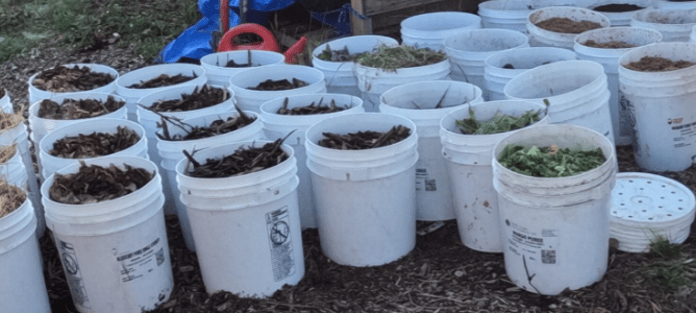
Below: Pouring the composing ingredients onto the blue tarp; next, tossing the mixture with rakes; finally, turning the mixture by lifting on side of the tarp.
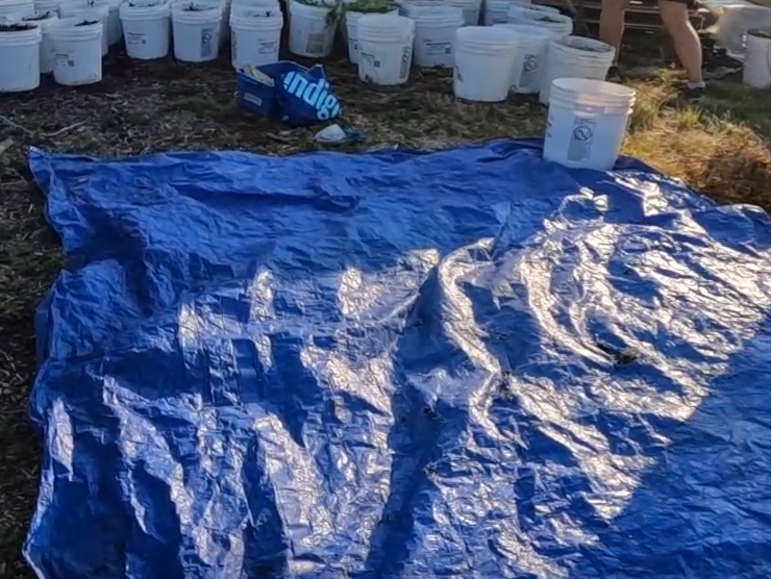
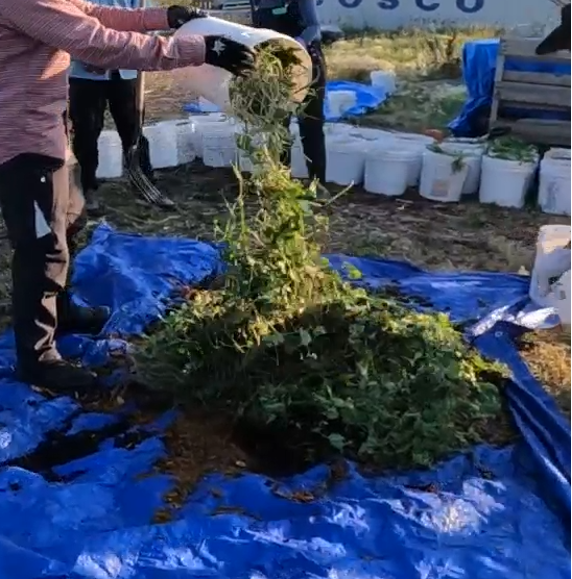


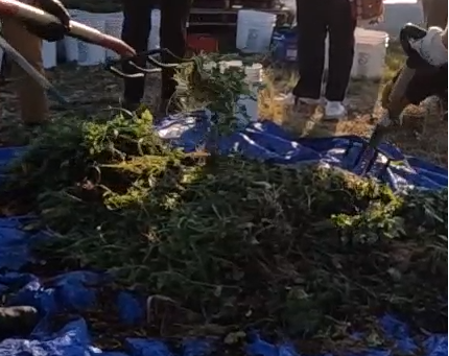
We then tossed the mixture using rakes and switched with our peers, so everyone had a chance to toss the compost. After tossing with the rakes, we then took two analogous corners of the tarp and lifted them which then flipped the mixture. After flipping the compost, we continued to mix it with the rakes. We continued this process and flipped the mixture about 2-3 times. Once the compost was completely combined, we then transferred the mixture to a large mesh storage container to let the compost develop.

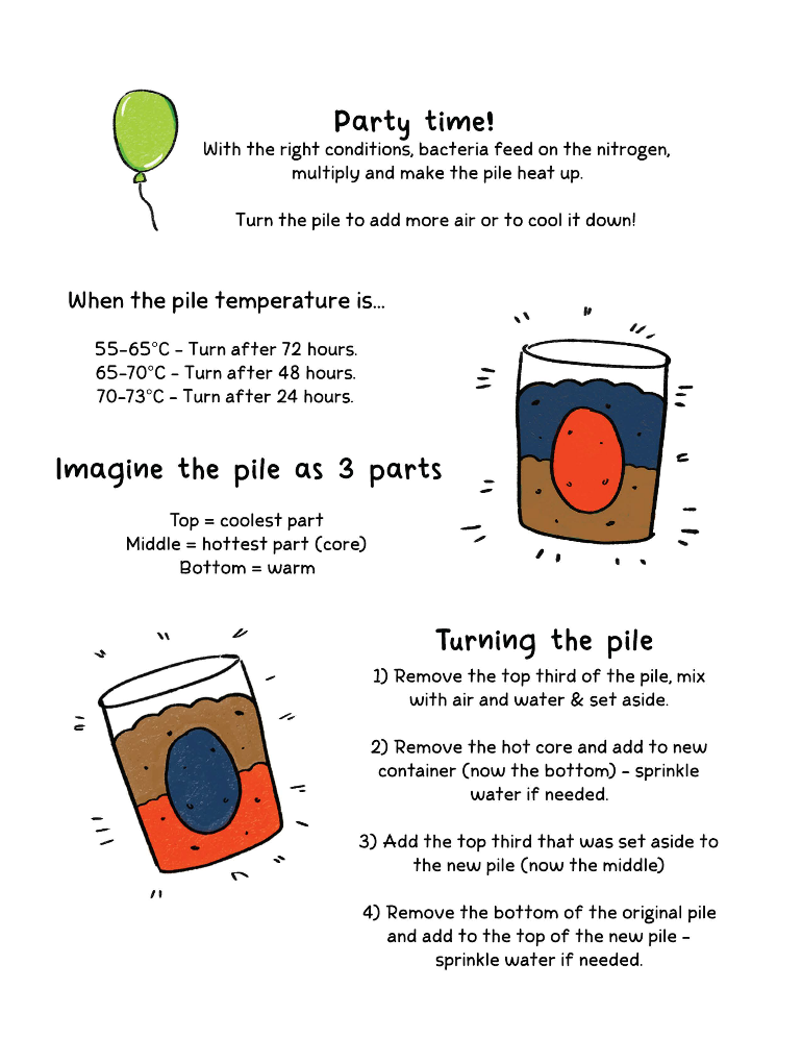
Tish mentioned that the chemical reactions that occur in the compost from the bacteria eating and reproducing make it very hot. The heat from the pile kills most seeds and pathogens, and it breaks down complex proteins. Therefore, during the 2-week thermophilic (hot) stage, one must regularly check the compost temperature and turn the pile every 3 days when it is over 55 °C. The purpose of turning a pile is to add air and water to temporarily cool the temperature and ensure the pile remains moist and aerobic. Anaerobic conditions could lead to pathogens and undesirable pests. Once the pile cools to ambient temperature, it can be left to mature for 3 – 6 months or up to 1 year.
This led to an exciting conversation about other ways to make compost. Many others shared their experiences on how they make compost; one mentioned required using worms and another method required fermentation. It was an interesting conversation about the different ways to make compost.
Looking at Compost through a Microscope
We then visited other batches of compost that had been fully developed and are ready to be used in the gardens. Different types of mushrooms were growing in one batch. The compost that was ready to use, turned into a dark brown/black color with a faintly sweetish smell. Many community members (including myself) were excited to see the fungus and mushrooms in the mature heap of compost.
Observing different compost samples under the microscope was a wonderful experience as well. We all gathered in a trailer and saw some living organisms in the compost through Tish’s computer attached to a microscope. A highlight of this experience was seeing a nematode in the compost. The nematode was fast, which also piqued the interest of other community members.


Above: Images of organisms in the compost are seen through a microscope.
Conclusion
During the compost workshop, I met many members of the community who shared a common interest in making compost in the workshop. I thought it was a special experience because I felt no shred of awkwardness at any moment of the day. It was a fun experience and a comfortable atmosphere between fellow community members of different ages and upbringings. There were many conversations and moments where people shared their knowledge and experiences, and I thought that was a valuable way to be a part of the Land of Dreams community. Whether you are sharing your story, or listening to someone else’s stories, being present, engaging, and/or being open to learning are some ways you can be involved in your community. Moreover, I learned so much about the science and labor behind making compost. It was an insightful experience and one that I would love to be a part of again.
References
Keena, M., Meehan, M., Scherer, T. (2022). Environmental Implications of Excess Fertilizer and Manure on Water Quality. NDSU. https://www.ndsu.edu/agriculture/extension/publications/environmental-implications-excess-fertilizer-and-manure-water-quality
 Soil Camp